Ahmed Saqer
What Are Tariffs?
If monkeys had tariffs, what would the animal kingdom look like? Can the current administration learn a bit from monkeys? Supply and demand are not a human-exclusive concept and thus, maybe – just maybe – by learning from the monkeys we humans in our grandeur can make better economic decisions – or so I hope.
This paper aims to demystify tariffs, trade, and international economics by using simple analogies and real-world data. We’ll explore how these concepts affect consumers, governments, and markets—and how countries’ decisions impact one another. Let us get down to the monkey business.
Trade vs. Autarky: Monkey Edition
Imagine a scenario with two monkeys, each on their own island. Bananald Trump is sitting in the sun with a ton of bright yellow bananas, while Mao-Key has an island full of juicy mangos. Here’s the catch: Bananald Trump has an island full of bananas, and Mao-Key has an island full of mangos. In economic terms they each have a comparative advantage in the ability to produce each of their fruits..
At first, they lived in autarky — a world with no trade. But Bananald Trump starts craving a mango, and Mao-Key wants some bananas. This is where trade comes in. At this present time Bananald Trump’s only way of getting a banana is from Mao-key and vice-versa. This is what trade is all about. Countries do it for the same reason: trade allows us to access goods we would not be able to produce on our own.
MonKeynesian Economics
The current US administration seems to like the idea of Keynesian economics — boosting demand can drive economic growth, and tariffs can be part of that strategy. Keynes believed having net-positive exports increases demand and boosts an economy, devaluing exchange rates can make exports cheaper and boost spending, and government intervention was essential to avoid economic downturn. Keynes was a strong believer in the consumer and the role of boosting the economy through demand.
But here’s the twist: tariffs aren’t a magic bullet. Yes, there is a possibility that they may support U.S. manufacturers, but they inevitably make things more expensive for everyone. If tariffs are imposed on Mao-key, the price of mangos goes up for Bananald Trump. But since tariffs are applied after importation, it’s the Trumpian consumer footing the bill—while Mao-key loses business due to falling demand.. The question is, is anyone really benefiting here?
Chimp-ports and Ex-chimp-orts
Let’s examine the relationship between Bananald Trump and Mao-Key further.
If Bananald Trump is a heavily exporting country and exports all his bananas to China it will decrease domestic banana supply. With less bananas in the country, prices of bananas will go up. The opposite effect is also true; all things held equal, a heavily importing country will find that prices of imported goods will go down. We see this in the real world as well
The U.S. is a big player in the global trade game, importing trillions of dollars in goods. The idea behind tariffs is to make foreign products more expensive, pushing people to buy American-made goods. But the downside? We lose access to cheaper, more varied goods, and prices for consumers go up.
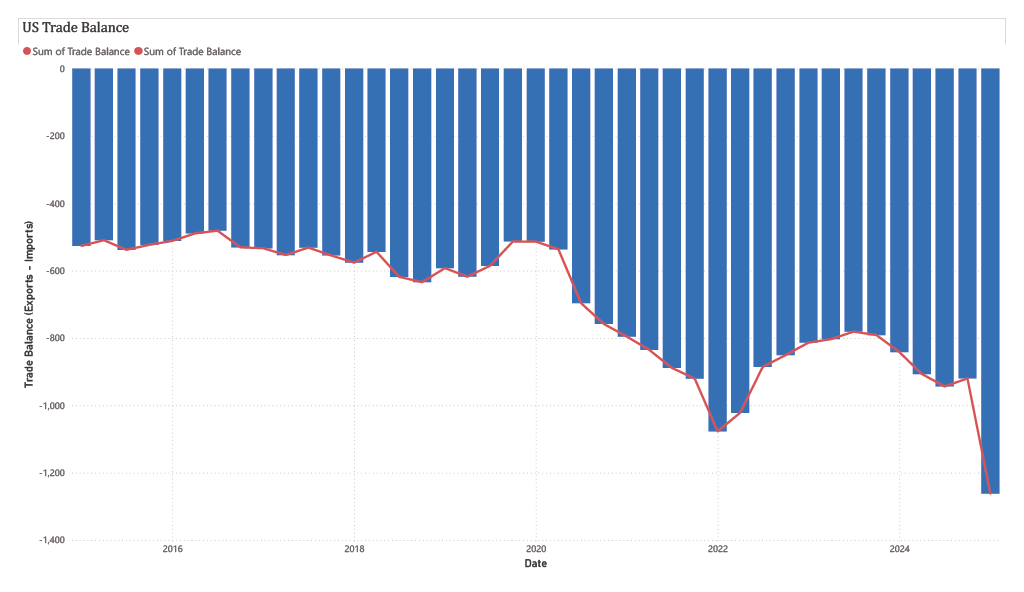
The US has consistently shown an increase in the trade deficit implying growing importation/decreasing exportation. With the trade deficit reaching 140 billion dollars, many consumer products are either directly imported or contain imported parts. Numbers don’t show the benefit of variety that comes with heavy importation. Bananald Trump can enjoy both mangos, bananas and whatever else it can import and Americans too enjoy the benefit of international products in food, clothing and automobiles due to the heavy importation policy of the US. This is crucial in our discussion on tariffs. If Mao-Key now has to pay 10, 20 or even 200% on mangos when sending them to the US what will happen to Bananald Trump? Some possibilities are lower import volume (which means less mangos for Bananald Trump) and increased prices due to lower supply. The question is if the tariff money isn’t going to Bananald Trump then who on his island is really benefiting?
CPI vs Wage Growth: A Real-World Impact
The Consumer Price Index (CPI) tracks the rise in prices for everyday goods. The CPI helps governments measure inflation for the everyday consumer. Consider the case in which prices go up faster than your paycheck: you are increasingly less able to afford your day to day goods. Wages in the U.S. have been lagging behind the rise in CPI for years, and tariffs could make that gap even worse.
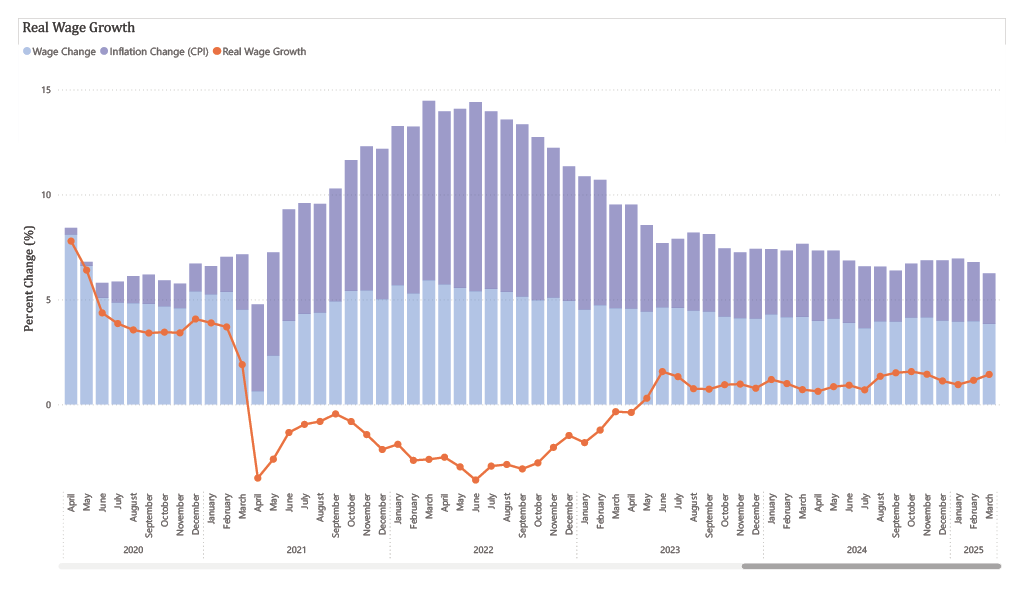
If bananas and mangos are more expensive, but your salary doesn’t increase, you end up with less purchasing power. The middle class usually feels this the most: prices go up, but middle class wages don’t keep pace.
How Tariffs Affect Supply, Demand, and Consumers
So, what happens when tariffs are slapped on imports? In simple terms, it disrupts supply and demand. With an increased charge being added to importers upon receival of goods, the demand for imports decreases due to the increased price. With fewer imports desired, the supply of foreign goods drops, and the prices for those goods rise. Now, you’re paying more for mangos (thanks, tariffs).
And that’s not all: tariffs lead to higher prices across the board. The things you buy every day—groceries, electronics, clothes—all become more expensive. The whole world’s trade system gets a little more complicated, and we all feel its effects.

In 2024, the US, Japan, Germany and China all saw decreases in their inflation rates signaling immense improvement for the average consumer. However, with a now utterly disruptive trade war we may see these inflation rates increase. Bananas just got more expensive- and so will everything else.
Ape-reciation vs. Depreciation
With Bananald Trump and Mao-Key now trading with each other there has to be some value of bananas to mangos. Is a mango worth one, two, or even 5 bananas? Exchange rates work in a similar fashion but have much greater implications. When countries mess with tariffs, they can mess with currency value, too. If the U.S. puts tariffs on foreign products, foreign buyers might start buying less, which could make the U.S. dollar stronger. But a stronger dollar can make American exports more expensive, which is not great for exporters.

The numbers show that since the inauguration of President Trump in Jan 2025 the US dollar has depreciated against many of its largest trade partners in Europe and Japan. This makes buying items in those currencies more expensive for the US buyer. Interestingly enough, CNY has seen little change implying that the strong trade relationship and strength of the US position on China may be keeping rising prices on Chinese goods at bay. It’s a tricky balancing act, and it’s not always clear who benefits. Think about it like this: if Bananald Trump’s currency appreciates because of fewer imports, his bananas become more expensive for Mao-Key to buy. So now, both monkeys could end up worse off.
Tariffs and the Prisoner’s Dilemma
Here’s where it gets interesting: tariffs can lead to a game of Prisoner’s Dilemma. The Prisoner’s Dilemma is a game theory concept that concludes when two parties make decisions based on their own self-interest, they may both end up worse off than if they had cooperated. If both Bananald Trump and Mao-Key start imposing tariffs on each other, they’re both worse off. Sure, they’re trying to protect their own economies, but in the end, both monkeys could end up with fewer goods and higher prices.
This is exactly what happens when countries go into a trade war. Tariffs seem like a quick fix, but they often escalate into bigger problems. It’s as if each monkey is trying to exceed the other, but in the end, everyone loses.
The Fed Goes Bananas
Governments use tariffs to protect local jobs, raise revenue, and address trade imbalances. But here’s the catch: too much government intervention can backfire. When tariffs create a trade war, it’s not just about losing bananas — the whole economy can slow down.
While tariffs have their place, they need to be used wisely. The risk of total economic slowdown in a dangerous game currently being played. Currently, we are seeing a market downturn, consumer backlash and international turmoil.
At the end of the day, tariffs are a double-edged sword. They can protect local industries, but they also raise prices for consumers and complicate global trade. The goal should be to find a balance—one that promotes domestic growth without hurting the consumer or the global economy.
Whether you’re a policymaker or a banana-loving monkey, understanding tariffs is essential to making better decisions about the economy. Because in the end, we all want to make sure we’re getting the best bananas—and mangos—at the best price.

 Saqer's Portfolio and Blog